The backends
All three backends implement the same small protocol:
 allocate(n)            → state            (|0…0⟩, 2ⁿ complex64 amplitudes)
 apply_matrix(state, U, targets, controls) → state
 measure(state, qubits, collapse=…)        → outcomes      (projective)
 sample(state, qubits, shots)              → Counter       (Born-rule sampling)
 abs2sum / expectation_pauli / to_numpy    → host-side observations
They are differential-tested against each other to ~1e-5, so the choice never affects what you compute — only how fast, and how many qubits fit. What actually differs is where the amplitudes live and who sweeps them:
              CPU                    MLX                      Metal
        ┌──────────────┐     ┌────────────────┐      ┌──────────────────┐
 state  │ NumPy array  │     │ mx.array in    │      │ one MTLBuffer in │
 lives  │ in RAM       │     │ unified memory │      │ unified memory   │
        └──────┬───────┘     └───────┬────────┘      └────────┬─────────┘
               │                     │                        │
 gates  CPU cores sweep it    GPU kernels from a       GPU kernels, encoded
 run    (chunked BLAS GEMM)   lazily-built graph       eagerly, in place
               │                     │                        │
 per    in place: chunk       out-of-place: every      in place: zero extra
 gate   scratch only          gate makes a new         copies (1× state,
        (~1.03× state)        buffer (~2× state)       measured)
               │                     │                        │
 ceiling  RAM & patience      30 qubits (int32         33 qubits (64 GiB,
          (~24q practical)    shape limit)             64-bit indexing)
This page explains each backend's design; the measured performance comparison and tuning guidance live in Backends: CPU vs MLX vs Metal.
Backend selection
Simulator() (i.e. backend="auto") routes by qubit count using measured crossover
points, not guesses:
   n ≤ 15      → cpu     (state ≤ 0.25 MB: GPU dispatch latency would dominate)
   n ≥ 16      → metal   (if installed)
                 mlx     (fallback, up to its 30-qubit ceiling)
                 cpu     (last resort)
The boundary is a property of the chip; MACQUEREL_BACKEND_TIERS=auto re-measures
the CPU/GPU crossover once on your machine and caches it, and an integer value pins
it. The reasoning is a fixed-vs-scaling cost argument: GPU work per gate doubles with
every qubit while launch overhead stays constant, so there is always a crossover —
see the performance page for
the measurement.
CPU: the NumPy reference
backends/cpu.py is the semantic reference the GPU backends are tested against. A
dense gate transposes the (2,)*n view so the target axes lead (a stride trick, no
data movement), then sweeps the non-target axes in cache-sized chunks: gather a chunk
into contiguous scratch, one BLAS matmul, scatter the result back to the same
positions — safe in place because each group depends only on its own amplitudes,
the same argument that makes Metal's kernels race-free. Diagonal gates take a
broadcast in-place multiply instead (one read + one write per amplitude, no temporary
— required for the wide fused diagonals the compiler emits, where a 10-qubit diagonal
as a dense 1024×1024 matrix product would be slower than the gates it replaced).
The chunked in-place sweep replaced an np.tensordot contraction whose out-of-place
copies (internal permutation, output, write-back) peaked at ~3× the state; peak now
sits at ~1.03× (the measured multiplier in benchmarks/data/memory.json — a 28q GHZ
peaks at 2.05 GiB) and the chunked GEMM is also faster everywhere, up to 1.7× on
scattered-target circuits. Practical to ~24 qubits; beyond that it is GPU territory.
MLX: a lazy compute graph on the GPU
MLX is Apple's machine-learning array framework.
Arrays live in unified memory and operations are lazy: mx.multiply, mx.matmul
etc. don't execute — they append nodes to a compute graph, which runs only when
something forces evaluation (mx.eval, or reading values back). For a circuit this
is a natural fit: the whole gate sequence becomes one graph that MLX's scheduler
fuses and executes in a handful of kernels, and nothing synchronizes with the host
until you ask for results.
   h(0)      cx(0,1)     rz(1,θ)         statevector()
    │           │           │                  │
    ▼           ▼           ▼                  ▼
  [node] ──► [node] ──► [node] ──► … ──►  mx.eval(graph)
                (graph building: microseconds,        (GPU executes the
                 nothing runs yet)                     whole fused graph)
How the gate kinds map onto MLX (backends/mlx_backend.py):
- Diagonal — reshape the state so each target qubit gets its own length-2 axis
(gaps between targets collapsed, so the view stays ≤ 2k+1 dimensional) and
broadcast-multiply by the
(2,)*kdiagonal. One elementwise kernel, no index table. - Permutation — a custom kernel with the dense path's one-thread-per-group
design: each thread computes its group's 2ᵏ gather indices in registers and
applies the per-row phases. The earlier implementation built the per-amplitude
source index as full-width graph arrays (
mx.arange+ bitwise ops); those intermediates — ~5 GiB of uint32 per fused 4-qubit permutation at 28q — were the dominant term in MLX's peak memory and the lazy graph kept several alive at once. Gates wider than 6 qubits fall back to that gather path. - Dense — a custom kernel written through
mx.fast.metal_kernel, with the same one-thread-per-group design as the native Metal backend (the gate width is baked into the kernel source so the per-row loops unroll into registers). This replacedmx.tensordot, whose internal permutation of the state was the dominant cost on scattered-target circuits. Gates wider than 6 qubits (which fusion never emits) fall back to tensordot.
Two structural costs are inherent to the design. First, MLX arrays are immutable, so
every gate writes a fresh buffer — the state is effectively double-buffered, and
a long lazy graph can keep many full-width intermediates alive. The backend bounds
this three ways: it calls mx.async_eval every 16 gates (every 2 above 26 effective
qubits) so MLX retires and frees earlier intermediates; because async_eval never
blocks — a shallow circuit can encode its entire graph before the GPU retires
anything — it keeps at most two checkpoints in flight, waiting on the previous one
before issuing the next; and observation boundaries return MLX's buffer pool to the
OS when it exceeds an eighth of unified memory. Together these hold peak memory to
~3–5× the state (down from ~20× before this line of work) — enough to run 29–30
qubit statevectors without swap. Second, MLX's shape elements are int32, so an
array of 2³¹ elements is rejected outright: 30 qubits is a hard ceiling, and the
reason the native Metal backend exists.
One more trick worth knowing about because it shows up in the code as MLXState.perm:
after the wide-gate tensordot fallback the contracted axes land in front of the
output rather than back in their original positions. Restoring them costs a full transpose (a copy), so
the backend doesn't — it records the axis permutation on the state object and folds
it in once, at the next readback. Bookkeeping instead of bandwidth.
Metal: in-place kernels, 64-bit indexing
backends/metal_backend.py drives the GPU directly through
Metal (via PyObjC), with shader
source compiled at runtime — no offline toolchain, the package stays pure Python.
It exists for what MLX structurally cannot do:
- 64-bit indexing. All index math in the kernels is
ulong; states of 2³¹+ amplitudes are fine. With in-place updates, a 33-qubit state is one 64 GiB buffer — it fits a 128 GiB machine. - Genuine in-place updates. Each thread owns one group (the 2ᵏ amplitudes sharing its non-target bits — disjoint by construction, so there are no races): read the group, multiply, write back to the same locations. Measured peak memory sits on the theoretical 2ⁿ×8-byte line. Halving the bytes moved per gate relative to a double-buffered design is also a speed win in a bandwidth-bound regime.
The state is a single MTLBuffer of float2 (bit-identical to NumPy complex64),
in unified memory with shared storage mode — so host readback is a zero-copy
np.frombuffer view, and measure/sample can reuse the CPU implementations on
that view directly. Three kernels mirror the gate kinds: diagonal (one thread per
amplitude), monomial (gather + phase per group), dense (matrix–vector per group,
controls checked with an early-out).
The driver layer is where Metal's overheads get engineered away:
  apply_matrix calls          one open command buffer            GPU
  ───────────────────         ───────────────────────────       ─────
  h(0)      ─ encode ──►  ┌─────────────────────────────┐
  cx(0,1)   ─ encode ──►  │ dispatch │ dispatch │ … (≤256)│ ──► executes in
  rz(1,θ)   ─ encode ──►  └─────────────────────────────┘      encoding order
  …                                   │
  statevector()  ── flush: commit + waitUntilCompleted ─┘
                    (the only CPU↔GPU sync point)
- Batched command encoding — gate dispatches are encoded into one open command buffer and only committed at observation boundaries (readback, measure, sample) or every 256 dispatches. A run of gates pays one commit and one sync instead of one each; a serial encoder guarantees execution in encoding order, so no barriers are needed.
- Per-width specialized pipelines — the gate width
kis baked into the shader as a preprocessor macro, so the compiler unrolls every per-row loop and sizes the per-thread arrays exactly; pipelines are cached per (kernel, k). - Shared process-wide objects — device, queue, compiled libraries, and pipelines
are module-level singletons: creating them cost ~7.5 ms per
Simulatorcall in auto mode, now paid once per process. - Buffer pooling and constant caching — state buffers are recycled on a free list (re-touching warm pages beats faulting fresh ones), small constant buffers (gate matrices, index tables) are cached by content, and redundant per-dispatch buffer re-binds are skipped.
The result is a backend that is fastest everywhere ≥ 16 qubits, not just past MLX's ceiling — see the measurements.
How many GPUs? One — the question is how full it gets
A point worth making explicit, because "MLX vs Metal" can sound like different
hardware: every simulation in this library runs on at most one GPU. Apple Silicon
has a single integrated GPU on the same die as the CPU (the M5 Max benchmark machine:
40 GPU cores behind one unified-memory controller); there is no multi-GPU
configuration to enumerate. MLX and the Metal backend are two software paths to the
same physical device — MTLCreateSystemDefaultDevice returns the one GPU either way
— and the CPU backend never touches it at all.
What actually varies with qubit count is occupancy: how much of that one GPU a dispatch can fill. A k-qubit gate launches one thread per group, 2ⁿ⁻ᵏ threads total, and a GPU with thousands of ALUs needs tens of thousands of threads in flight to hide memory latency:
                 threads per dense-4 gate     one 40-core GPU
 n = 12               2⁸  =   256             starved — most cores idle, and the
                                              launch overhead dwarfs the work
 n = 20               2¹⁶ =  65 536           roughly at the latency-hiding knee
 n = 30               2²⁶ ≈  67 M             saturated — bandwidth-bound, the
                                              regime the backends are built for
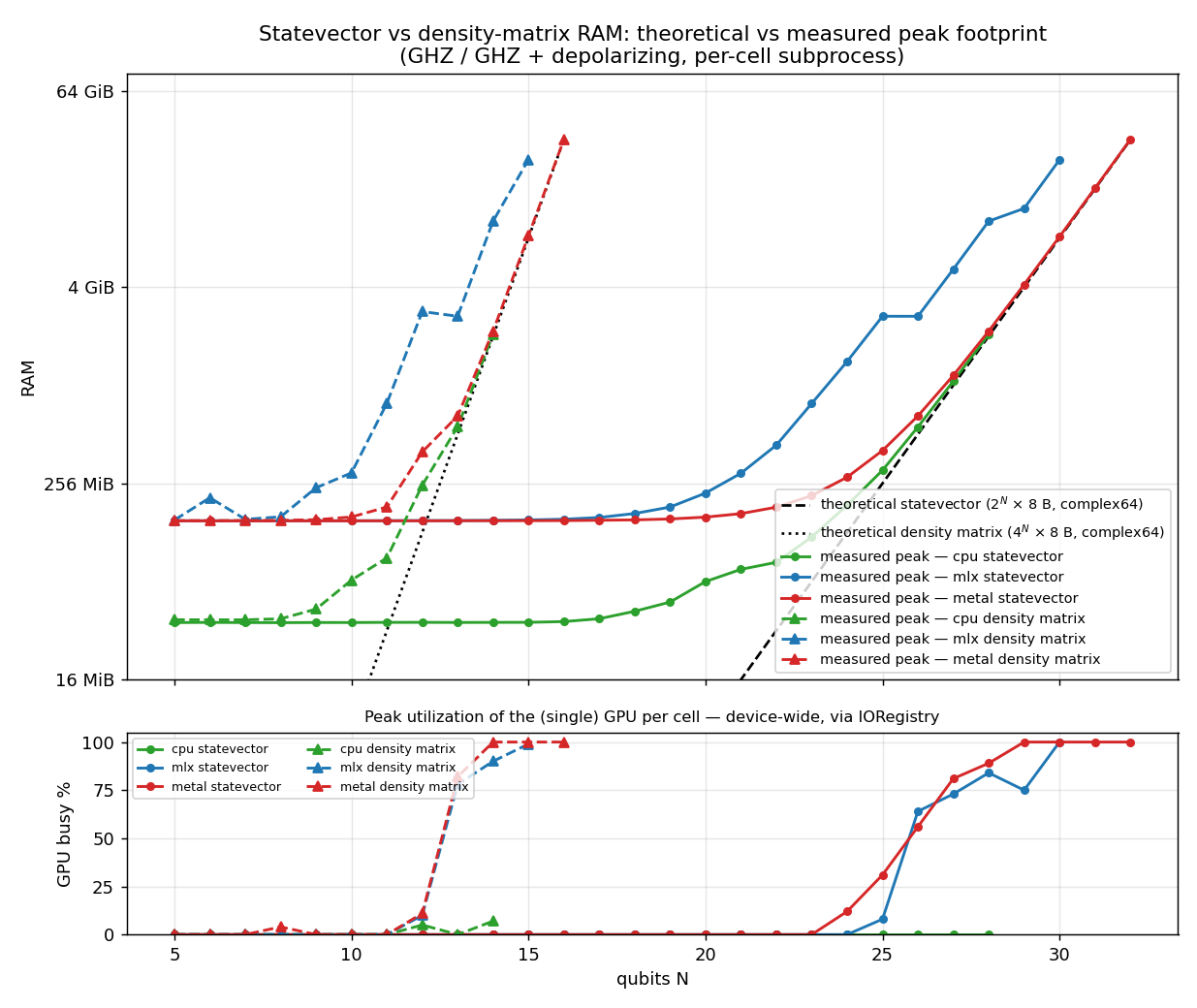
This is the hardware face of the small-n story: below ~16 qubits the GPU isn't slow, it's empty, and auto-select keeps those circuits on the CPU. The memory benchmark measures this directly — while each cell runs, it samples the GPU's device-wide busy-percent from the IORegistry (the same counter Activity Monitor plots). The utilization panel of the chart below shows the measured curve (GHZ cells, M5 Max):
- cpu cells never leave the idle baseline at any qubit count — the CPU backend genuinely uses no GPU;
- metal breaks from the baseline at 24–25 qubits (12%, 31%) and saturates from 29 qubits;
- mlx breaks out at 26 qubits (64%) and pins the GPU at 100% from 30 qubits;
- density-matrix cells, being doubled states, get busy at tiny qubit counts: ~80% at n=13 (a 26-qubit state) and 100% from n=14 on Metal.
Busy-percent is a duty cycle over the whole cell (including Python startup and encode time), so lower at the same qubit count means the same circuit finished with less GPU work — which is why these breakout points sit later than they used to: before the memory line of work, MLX left the baseline at 22 qubits and pinned the GPU from 24, because its permutation path was moving ~20× the state in index intermediates. Device-wide busy-percent is not a per-core occupancy probe, but on an otherwise idle machine it cleanly separates "the GPU barely woke up" from "the GPU is the bottleneck".
Memory at a glance
Peak resident memory, measured by benchmarks/bench_memory.py against the
theoretical 2ⁿ×8-byte state (multipliers from benchmarks/data/memory.json):
            theory      cpu        mlx        metal
 statevector 2ⁿ×8 B     ~1.03×     ~3–5×      ~1.0×  (in place)
 density mx  4ⁿ×8 B     ~1.03×     ~3–5×      ~1.0×
Both non-Metal multipliers used to be far worse and fell to these values in the v0.3.x RAM line (commits and A/B data in the completed plan): CPU's tensordot copies (~3×) became the in-place chunked sweep, and MLX's ~20× of permutation-index intermediates became the register-resident kernel plus eval backpressure described above — which is also what un-blocked MLX's 29–30q statevectors and 15-qubit density matrices. What remains of the MLX multiplier is the lazy graph's double-buffering and pool. When a working set approaches physical RAM, macOS starts swapping and runtimes fall off a cliff — the memory benchmark budget-gates its cells for exactly this reason, and it is usually what a "slow" 28q+ run turns out to be.
Next: Optimizations — the compiler passes and tuning machinery that sit on top of these three engines.