macquerel

A quantum state-vector simulator targeting Apple Silicon's unified-memory architecture.
Install
Quickstart
from macquerel import Circuit, Simulator

circuit = Circuit(2)
circuit.h(0).cx(0, 1).measure_all()

sim = Simulator()                  # auto-selects a backend
counts = sim.run(circuit, shots=1000)
print(counts)  # Counter({'00': ~500, '11': ~500})
Backends
| Backend | Range | Notes |
|---|---|---|
| CPU (NumPy) | ≤15q | Reference implementation |
| Metal | 16–33q | PyObjC kernels, 64-bit indexing, in-place |
| MLX | 16–30q | Apple Silicon GPU; fallback when Metal is unavailable |
Simulator() selects automatically by qubit count; pass backend="cpu" / "mlx" / "metal"
to force one.
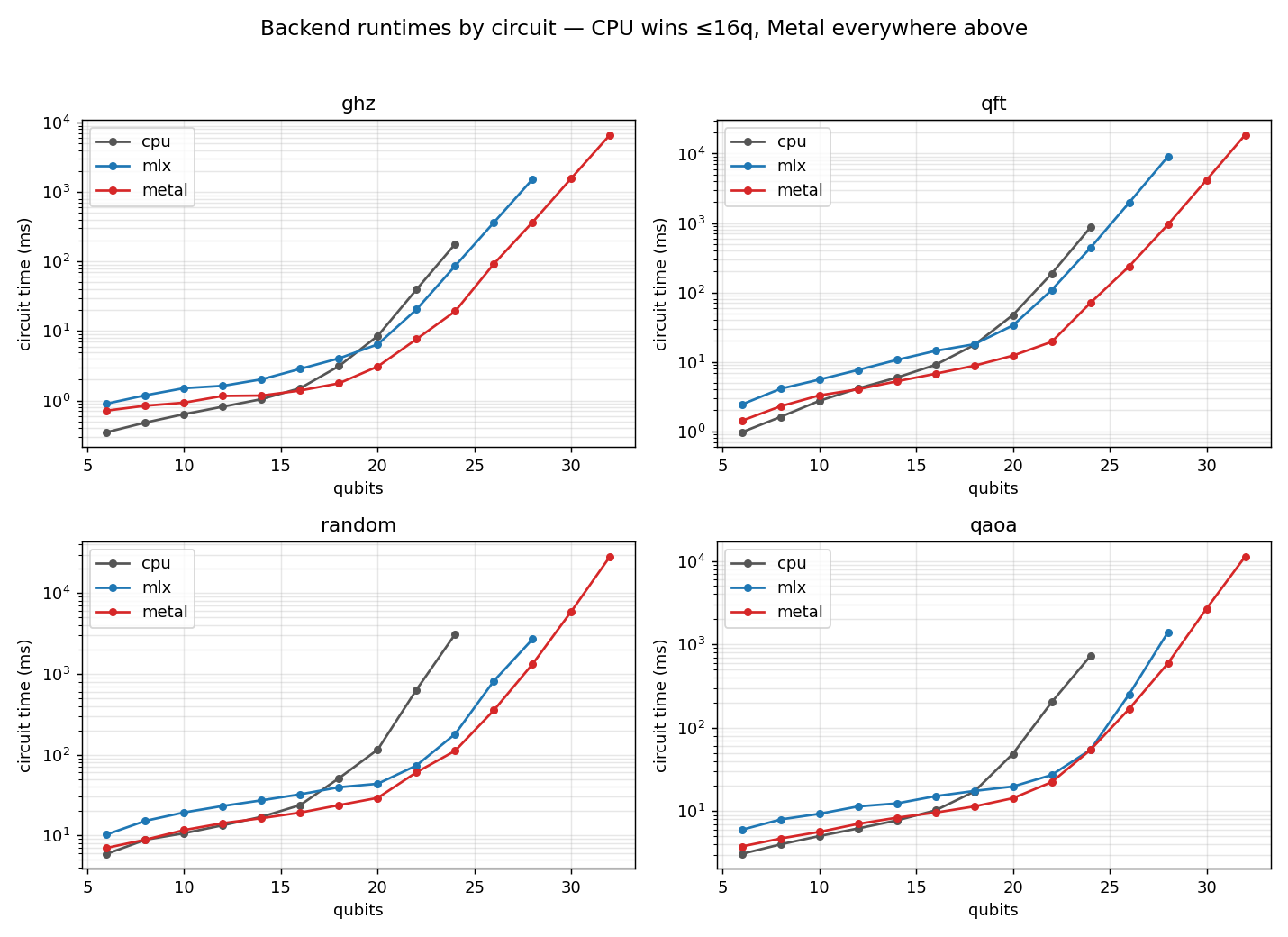
Circuit time by backend (log scale) on an Apple M5 Max. Past 30 qubits only the Metal backend can allocate the state.
Each backend wins a different regime:
- CPU (NumPy) — the portable reference. Fastest at ≤15q, where the state vector is only a few MB and per-gate GPU dispatch latency would dominate. Time and memory become impractical beyond ~24q. Pro: runs anywhere, no GPU. Con: doesn't scale.
- Metal — custom PyObjC kernels with 64-bit indexing and genuine in-place updates. The fastest backend everywhere ≥16q (batched command buffers and specialized kernels removed the per-gate sync that used to hold it back at mid sizes), and the only one past 30q, reaching 31–33q (16/32/64 GiB states) at ~2× per added qubit — the bandwidth-bound ideal. At 24q it beats CPU by up to 28×.
- MLX — Apple Silicon GPU via a fused lazy graph. The fallback for 17–30q
when PyObjC-Metal isn't installed: far ahead of CPU (random circuit @24q 17×),
within 1.0–2× of Metal on nearest-neighbor circuits like QAOA, further behind on
diagonal-heavy ones like QFT. Cons: double-buffers every gate (≈2× memory), and
its
int32indexing hard-caps it at 30 qubits (2³¹ amplitudes).
See Backends for the measurements behind these tiers, why the GPU
loses below 16q, how circuit structure moves the MLX/Metal gap, and tuning tips.
For a guided tour of the internals — what statevector simulation is, how each
backend applies gates, and how the optimizations work — see
How it works.
For parameter sweeps of many small circuits, see BatchedSimulator — it packs the
whole sweep into batched array ops (up to 47× over a per-circuit loop).
Noise simulation
Circuits accept Kraus-operator noise channels (.depolarizing(q, p),
.amplitude_damping(q, gamma), …) and run on the DensityMatrixSimulator, which
carries the density matrix as a vectorized 2n-qubit state over the same three
backends. An n-qubit noisy simulation therefore costs what a 2n-qubit statevector
costs — up to 15 qubits on MLX and 16 on Metal (a 32 GiB state). See
Getting Started and the
API reference.